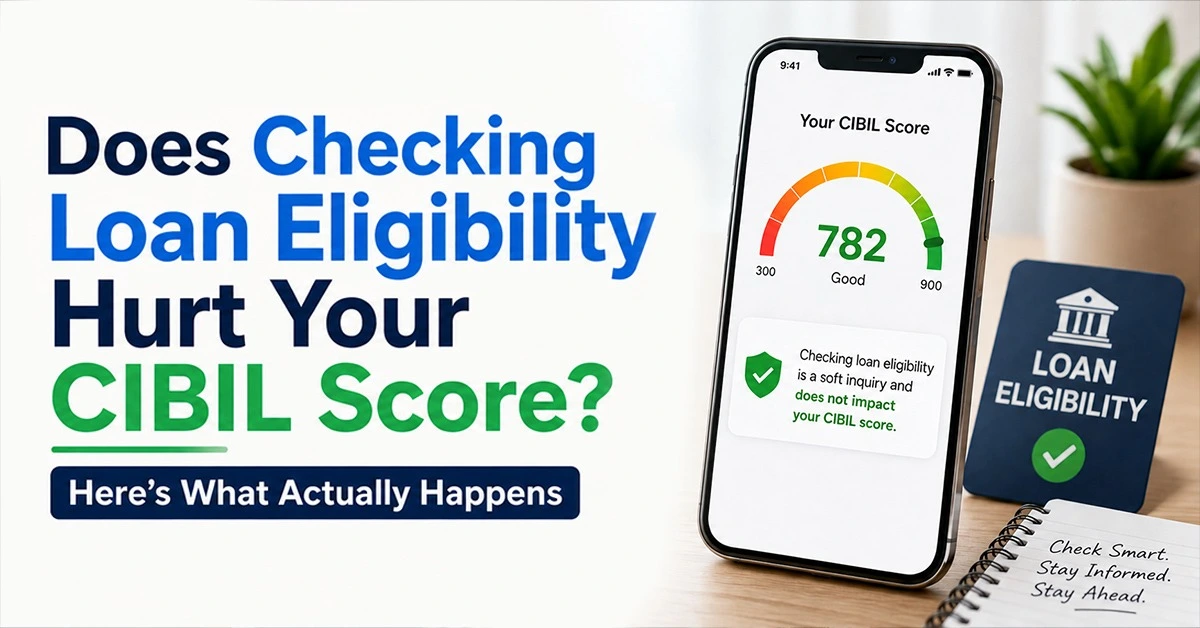
So you’re eyeing a personal loan. Maybe a home loan. Or perhaps you need working capital for your business. You’ve got the application form half-open on your browser — and then it hits you: “Wait, is this going to tank my CIBIL score?”
If you’ve had that moment of hesitation, you’re not alone. This is easily one of the most common anxieties borrowers in India carry around, and honestly, it’s not entirely unfounded. But it’s also not the full picture.
Here’s the short version: checking your loan eligibility and applying for a loan are two different things. One is harmless. The other can cost you credit score points you didn’t need to lose. Most people lump them together, and that confusion is where the damage happens.
Let’s sort this out properly.
Why This Question Matters More Than You Think
Credit scores aren’t just numbers on a screen. They’re gatekeepers. A good CIBIL score gets you lower interest rates, faster approvals, and better negotiating power with lenders. A poor one — or even a marginally lower one — can mean paying lakhs more in interest over the life of a loan.
The irony? Some borrowers hurt their scores in the process of trying to get a loan. Not because they defaulted or missed payments, but because they didn’t understand how the credit inquiry system works. That’s a fixable problem, and this article is the fix.
What Exactly Is a CIBIL Score?
Your CIBIL score is a three-digit number between 300 and 900, assigned by TransUnion CIBIL (which used to go by the longer name Credit Information Bureau India Limited). Think of it as a report card for your borrowing behaviour. It tells lenders, at a glance, how reliable you are with money you’ve borrowed.
Banks, NBFCs, fintech lenders — pretty much anyone who might lend you money — will check this score before making a decision. Generally speaking, a score above 750 puts you in the “comfortable zone” for competitive interest rates and smooth approvals. Dip below 650, and you’ll find doors closing or terms getting significantly worse.
How Your CIBIL Score Gets Calculated
CIBIL doesn’t share its exact formula (no credit bureau does), but they’ve been fairly open about which factors carry weight:
That last row is why we’re here. Credit inquiries account for a full 20% of your score. That’s not trivial. But here’s the catch — not every inquiry affects your score the same way. Some don’t affect it at all.
Soft Inquiry vs Hard Inquiry — This Is the Part You Need to Understand
Every time someone — including you — accesses your credit report, it gets logged. But the system draws a sharp line between two types of access, and that distinction makes all the difference.
Soft Inquiries: The Harmless Kind
A soft inquiry is when your credit information is checked for informational purposes, not as part of a formal lending decision. This includes things like:
You checking your own CIBIL score on the official website or any third-party app
A bank reviewing your profile to send you a pre-approved loan offer
An employer running a credit-related background check
A loan aggregator or eligibility tool assessing your basic creditworthiness
The key point: soft inquiries don’t touch your score. They’re invisible to other lenders. Check your score every single day if you want to — it won’t move a single point.
Hard Inquiries: The Ones That Leave a Mark
A hard inquiry is triggered when a lender formally pulls your credit report because you’ve submitted a loan or credit card application. You’ve given them explicit consent to dig into your full credit history as part of their decision-making process.
This is where the score impact kicks in. Each hard inquiry can knock your score down by anywhere from 5 to 15 points, depending on your existing credit profile. And it’s not just the point drop that matters — stack up several hard inquiries in a short window, and lenders start reading it as a distress signal. “Why is this person frantically shopping for credit?” is the question they’re asking themselves.
Side-by-Side: Soft vs Hard Inquiry
Does Checking Your Own Score Lower It?
No. Full stop.
Checking your own CIBIL score is a soft inquiry. It has zero effect on your score — not a temporary dip, not a hidden impact, nothing.
CIBIL itself actively encourages people to check their scores regularly. And for good reason: monitoring your report is how you catch errors early. Incorrect late payment entries, accounts you don’t recognise, outdated information that should have been cleaned up — these things happen more often than you’d think, and they can silently drag your score down.
You get one free CIBIL report per year directly from the CIBIL website. Several banking apps and fintech platforms offer free monthly checks too. There’s really no reason not to keep tabs on it.
What Actually Damages Your CIBIL Score
Now that we’ve cleared up the inquiry confusion, let’s talk about the things that genuinely hurt your score — because this is where attention should really go.
Late or missed payments are the single biggest score killer. One payment that’s even 30 days overdue can slash 50 to 100 points off your score. A 90-day default? That stain lingers on your report for years. If you take nothing else away from this article, set up auto-pay for everything.
Running up your credit card is the next big one. Financial advisors generally recommend keeping your utilisation below 30% of your available limit. Consistently maxing out your cards — even if you pay the full balance every month — tells the scoring system you’re too dependent on credit.
Submitting too many loan applications at once is exactly the scenario we’ve been discussing. Five applications to five different lenders in the same month means five hard inquiries, and the cumulative damage can be substantial.
Settling a loan for less than you owe might feel like a relief at the time, but your report will show the account as “settled” rather than “closed.” Lenders treat this almost as poorly as a default.
Having no credit history at all is its own problem. If CIBIL doesn’t have enough data to work with, you either get a very low score or no score at all. It’s the classic catch-22 — you need credit to build credit.
Closing your oldest credit card can hurt more than people expect. It shortens your average credit age, which is one of the factors the score relies on.
How to Check Loan Eligibility Without Triggering a Hard Inquiry
This is where being smart about the process pays off. There are several ways to gauge whether you’ll qualify for a loan without leaving any marks on your credit report.
Start with eligibility calculators. Platforms like Loanedz offer tools that estimate your approval chances based on your income, employment, existing obligations, and general credit profile — without touching your CIBIL report. These generate soft inquiries at most, and sometimes no inquiry whatsoever.
Look at pre-approved offers. Banks and NBFCs frequently run soft checks on existing customers and push pre-approved loan offers. These are preliminary assessments — no hard inquiry happens unless you formally accept and proceed with the application.
Check your own score first. This seems obvious but a surprising number of people skip it. If your score is sitting below 700, you’re better off working on improving it before applying anywhere. This saves you from collecting hard inquiries on applications that were probably going to be rejected anyway — rejections that would push your score even lower.
Use aggregator platforms that run soft checks. When you explore loan options through a platform like Loanedz, the initial matching process doesn’t require a formal credit pull. You can see which lenders are likely to say yes before you commit to a full application.
The Real Risk: Shotgunning Applications to Every Lender in Sight
Here’s the scenario that genuinely wrecks credit profiles, and it plays out more often than it should.
A borrower needs ₹5 lakh as a personal loan. Without checking their eligibility anywhere, they fire off applications to six different banks and NBFCs on the same day. Each lender runs a hard inquiry. Within two weeks, six hard inquiries show up on their CIBIL report. Their score drops by 40 to 70 points.
Some of those applications get rejected — partly because the later lenders can see the earlier inquiries and read them as desperation. Now the borrower’s score is worse than when they started, they have a pattern of rejections on their record, and their chances of getting decent terms on future applications have taken a real hit.
The frustrating thing is that all of this is avoidable. Check your eligibility through soft-inquiry channels first. Identify the one or two lenders where your profile is the strongest fit. Apply only to those. That’s it.
How Loanedz Helps You Navigate This the Right Way
This is the exact problem Loanedz was designed to solve. Instead of the spray-and-pray approach, here’s how the process works:
First, you share your financial basics — income, employment type, existing EMIs, and how much you need to borrow. No CIBIL pull happens at this stage.
Then, Loanedz matches you with the right lenders. Using its network of banking and NBFC partners, the platform identifies which lenders are most likely to approve you based on their specific criteria.
Finally, you apply with precision. One well-targeted application to the lender that fits your profile best. One hard inquiry instead of six. Your CIBIL score stays intact, your approval odds go up, and you’re more likely to land a competitive interest rate because your credit profile looks disciplined rather than desperate.
With over a decade in financial services and thousands of borrowers guided through this process, the Loanedz team has seen firsthand how much damage the scattershot approach causes — and how easily it’s prevented with a smarter workflow.
Practical Tips to Keep Your CIBIL Score Healthy While Loan Shopping
Whether you’re looking at personal loans, home loans, car loans, or business credit, these habits will serve you well:
Pull your own CIBIL report before doing anything else. Get the free annual report from the CIBIL website. Go through it carefully. If anything looks wrong — an account you don’t recognise, a late payment that wasn’t actually late — dispute it immediately.
Run eligibility checks before submitting applications. Platforms like Loanedz let you test the waters without a hard inquiry. Use them to narrow your options so you’re not applying blind.
If you’re applying to multiple lenders, space it out. Leave at least 30 to 45 days between applications. There’s some evidence that inquiries for the same loan type within a 14-day window get treated more favourably by some scoring models — but that’s not guaranteed with CIBIL’s system, so spacing remains the safer bet.
Don’t waste hard inquiries on long-shot applications. If a lender needs a ₹50,000 monthly salary and yours is ₹30,000, that’s a guaranteed rejection and a pointless ding on your report.
Get your credit card utilisation below 30% before applying. Pay down balances if you can. A lower utilisation ratio helps both your score and your approval odds.
Don’t close old credit accounts right before a loan application. The drop in average credit age can lower your score at exactly the wrong time.
Automate every payment you can. Set up auto-pay for all EMIs and credit card bills. A single missed payment can undo months of careful credit building.
Frequently Asked Questions
Does checking my CIBIL score online reduce it?
Not at all. Whether you check on the official CIBIL website, a banking app, or a fintech platform, it counts as a soft inquiry. No impact on your score, no matter how often you check.
How many points does a hard inquiry cost?
Typically 5 to 15 points per inquiry. The exact hit depends on your overall credit profile — someone with a thin credit history may see a bigger drop than someone with a long, established record.
How long do hard inquiries stay visible?
They stay on your CIBIL report for 24 months. The good news is their impact on your actual score fades over time, with most of the effect wearing off within 6 to 12 months.
Can I check loan eligibility without a hard inquiry?
Absolutely. Eligibility calculators, pre-approval checks, and platforms like Loanedz all let you assess your chances without triggering a formal credit pull.
Is there a difference between me checking my CIBIL and a bank checking it?
A big one. When you check your own score, it’s a soft inquiry — invisible to lenders and completely score-neutral. When a bank checks it because you’ve applied for a loan, that’s a hard inquiry — visible to other lenders and it costs you points.
How many applications are too many?
There’s no hard rule, but more than two or three hard inquiries within a three-month window starts raising flags. Five or more in a short period, and lenders may reject you on principle, regardless of your income or score.
Does a loan rejection hurt my score?
The rejection itself isn’t recorded on your report. But the hard inquiry the lender ran before rejecting you is. So while “rejection” doesn’t directly lower your score, the inquiry that led to it does — and a pattern of inquiries without any new accounts opening is a negative signal in itself.
Will using Loanedz trigger a hard inquiry?
No. The initial eligibility matching on Loanedz doesn’t involve a hard inquiry. A formal credit pull only happens when you decide to apply to a specific lender through the platform.